The Kakebo Method: The Complete Guide to Saving with Mindfulness
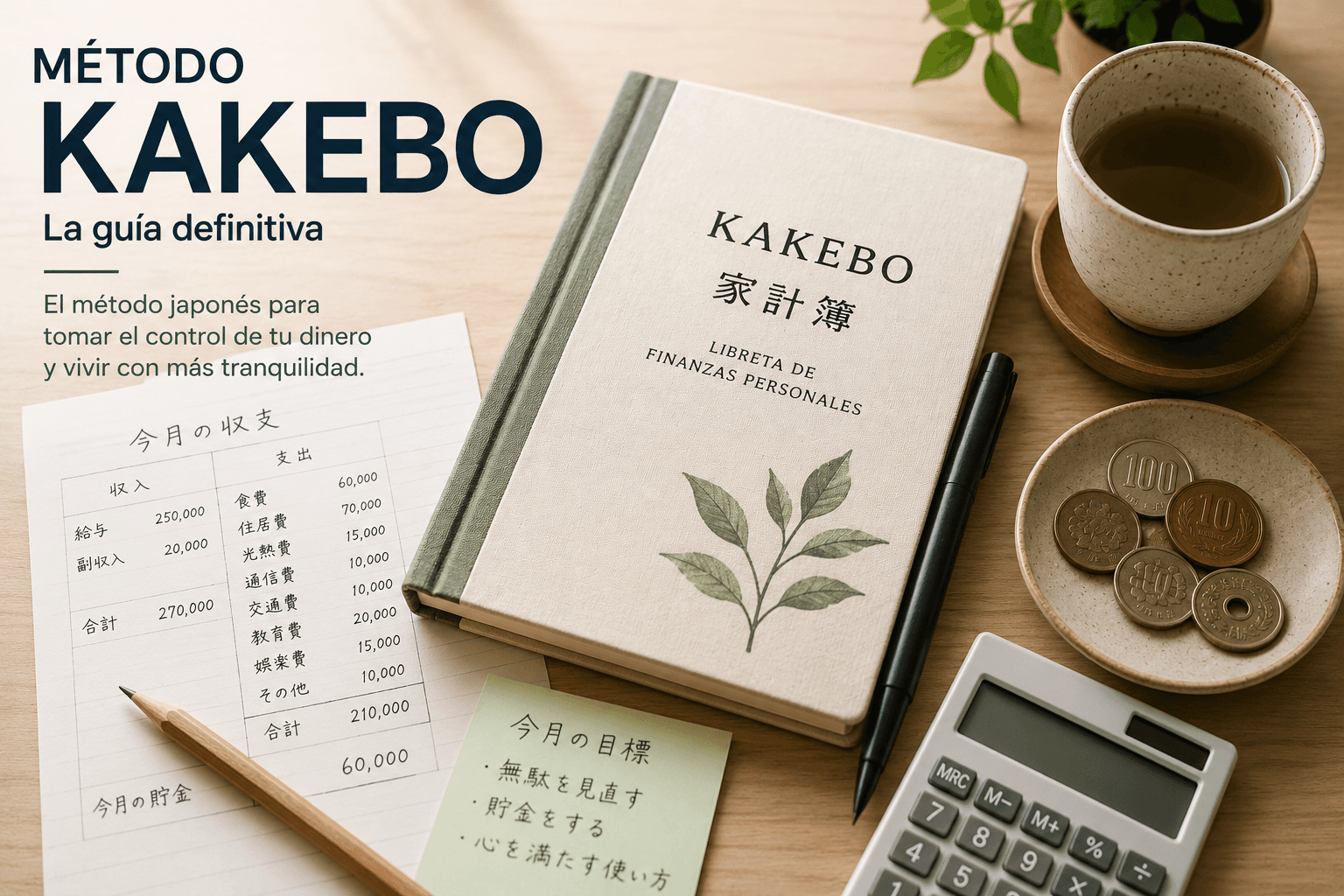
What is the Kakebo method?
Kakebo (pronounced "kah-keh-boh") is much more than a simple savings technique; it is a financial philosophy that was born in Japan in 1904 at the hands of journalist Motoko Hani. Its goal was simple but revolutionary: to empower Japanese women to take control of household finances.
Today, in the digital age, Kakebo remains surprisingly relevant. Why? Because unlike automatic banking apps that only show you what you have already spent, Kakebo forces you to be conscious of your financial decisions before and after making them.
"Kakebo is not about restricting your life, but about putting your money where your heart is."
How does Kakebo work?
The premise of Kakebo is simple. It is based on tracking your income and expenses (by hand or in a mindful app like Kakebo AI) and reflecting on them. The system divides expenses into four fundamental categories:
- Survival (Needs): Everything indispensable to live. Rent, mortgage, food, transportation, pharmacy, electricity, and water bills.
- Optional and Leisure (Wants): Expenses you enjoy but are not vital. Drinks with friends, tobacco, restaurants, fashion clothing, cosmetics.
- Culture (Extra): Investment in yourself. Books, courses, museums, theater, cinema.
- Extras (Unexpected): Unforeseen expenses. Car repairs, wedding gifts, medical emergencies, one-off trips.
The 4 steps of the Kakebo cycle
To apply the method correctly, you must follow a four-step monthly cycle:
1. Forecast (At the beginning of the month)
Calculate how much money you actually have available.
- Write down your Fixed Income.
- Subtract your Fixed Expenses (rent, subscriptions).
- Decide how much you want to Save this month.
- The remainder is your Available Budget for the day to day.
2. Tracking (During the month)
Log each expense in its corresponding category. Consistency is key. This is where an app like Kakebo AI shines, letting you log expenses via chat in seconds while maintaining awareness but eliminating the friction of paper.
3. Balance (At the end of the month)
Add everything up. How much have you spent in each category? Have you met your savings goal?
4. Reflection (The key to success)
This is the part that is missing from most Western methods. Answer these four questions:
- How much money do you have?
- How much money would you like to save?
- How much money are you actually spending?
- What would you change next month to improve?
Digital Kakebo vs Excel vs Paper
| Feature | Kakebo Notebook (Paper) | Excel / Spreadsheet | Kakebo AI (App) |
|---|---|---|---|
| Awareness | High | Medium | High |
| Ease of use | Low | Medium | Very High |
| Analysis | Manual (Slow) | Manual (Formulas) | Automatic (AI) |
| Portability | Poor | Poor (Mobile) | Excellent |
| Privacy | Total | Total (Local) | Total (Encrypted) |
Paper is romantic but not very practical today. Excel is powerful but tedious to maintain. Kakebo AI combines the conscious philosophy of the original method with the power of Artificial Intelligence to categorize and analyze your patterns without having to fight with formulas.
The story behind the method: Motoko Hani and 1904
Kakebo was not born in a Silicon Valley lab or a financial consultancy. It was invented by Motoko Hani, Japan's first professional female journalist, in 1904. Hani founded the magazine Fujin no Tomo (Friend of Women) with the goal of empowering Japanese housewives to take control of household finances without relying entirely on their husbands.
The account book she designed was simple but revolutionary for the time: structure household expenses into clear categories, record them by hand consciously, and dedicate a monthly moment to reflecting on what was spent. Not as an accounting exercise, but as a practice of self-knowledge.
More than 120 years later, the method survives because it touches something that no automatic categorization app can replicate: the conscious friction of manual tracking. Writing down an expense — even on a screen — activates a reflection that the automatic transaction in a banking app eliminates entirely.
The four questions that change your relationship with money
The Kakebo reflection step revolves around four concrete questions that you should answer in writing at the end of each month. They are not rhetorical; they are the heart of the method.
1. How much money do I have? Add up your current account balance plus any accumulated savings. This question forces you to look at the real number, not the mental estimate that tends to be more optimistic than reality.
2. How much money would I like to save this month? This question is answered at the beginning of the month, not the end. Setting the savings goal before you start spending completely changes the approach: instead of saving "whatever is left," you allocate to savings first and then live on the rest.
3. How much am I actually spending? This is where the monthly tracking shows its value. The sum of each category reveals patterns that memory systematically distorts. Most people underestimate their spending on Optional/Leisure by between 30% and 50%.
4. How can I improve next month? The most important question. It is not about punishing yourself for what was spent, but about identifying one or two concrete levers for improvement. "Next month I will do the weekly shop with a fixed list" is a valid answer. "I will spend less" is not: it is too vague to generate real change.
Kakebo with irregular income: the adaptation for freelancers
The original method assumes a fixed monthly salary, which works perfectly for salaried employees. But if your income varies each month — as happens with freelancers, self-employed workers, or people with seasonal jobs — you need a small adaptation.
The solution is to calculate your average income over the last 12 months and use that figure as the basis for your planning. In months where you exceed that average, the surplus goes directly to a separate reserve (what the adapted method calls a "Kakebo Cistern"). In lean months, you draw on that reserve to maintain the same standard of living without panicking.
If you are self-employed and want a specific guide, we have a dedicated article: Kakebo Method for Freelancers with Irregular Income.
Common mistakes when starting with Kakebo
Mistake 1 — Trying to be perfect from the first month. Kakebo is a habit system, not an immediate results system. The first month is for calibration: you understand your real patterns, not the ones you thought you had. Do not expect to save an impressive amount in 30 days; expect to know yourself better financially.
Mistake 2 — Miscategorizing expenses to make them look better. If you put tobacco under "Culture" or work dinners under "Survival" when they clearly are not, the system lies to you. The categories only work if they are honest.
Mistake 3 — Giving up if you miss a day or a week. You forgot to log three days' worth of expenses. No problem. Estimate as best you can and keep going. An imperfect record is infinitely more useful than no record.
Mistake 4 — Confusing Kakebo with a deprivation diet. The method does not tell you not to spend on leisure or treats. It tells you to be aware of how much you spend on them. That awareness, by itself, tends to reduce impulse spending without you having to ban yourself from anything.
Kakebo vs other popular savings methods
Kakebo coexists with other money management systems with which it is sometimes confused or compared.
Kakebo vs the 50/30/20 rule: The 50/30/20 rule (50% needs, 30% wants, 20% savings) is an income distribution guide, not a tracking system. You can use it as a reference for objectives and Kakebo as a monitoring tool: they are complementary, not mutually exclusive.
Kakebo vs YNAB: YNAB (You Need A Budget) is an American system based on assigning a "job" to every dollar before spending it. It is more rigid with a steeper learning curve. Kakebo is more flexible and behavioral; YNAB is more budget-based and strict. For more analytical profiles, YNAB may be better. For most people, Kakebo is more sustainable long term. Full comparison: Kakebo vs YNAB.
Kakebo vs banking apps: Your bank's apps show you what you have already spent automatically. Kakebo makes you actively log what you spend. The difference seems small but produces radically different results: the friction of conscious tracking activates a reflection that automatic categorization eliminates.
The psychological impact of Kakebo: How it rewires your brain
To truly understand why the Kakebo method has survived more than a century of technological innovations and economic crises, we must look beyond simple arithmetic and delve into contemporary behavioral neurology.
The neurobiology of spending
When you make a purchase, especially an impulsive one (a discounted item on Amazon, an expensive impromptu dinner), your brain releases an immense spike of dopamine. This neurotransmitter is deeply linked to reward and pleasure systems. The immediacy of the transaction (buying with one click, tapping your phone on the card reader) drastically shortens the reward circuit, almost completely blocking the intervention of the prefrontal cortex, the area of your brain in charge of critical thinking and long-term planning. It is literally a financial short-circuit induced by modern payment design.
Friction as an antidote
This is where the underlying magic of Kakebo steps in. The method works not because its categories are an ancient mathematical secret, but because it artificially and deliberately introduces a tactical friction into the spending cycle.
By forcing yourself to personally record that you have spent let's say $45 on Optional and Vices (whether strictly writing it down in pen in the traditional notebook's boxes or explicitly typing it and sending it to your Kakebo AI assistant), you imperatively force your brain to engage the prefrontal cortex once again. Turning something automatic and subconscious (swiping a contactless card) into an actively processed, conscious event.
The financial "Zeigarnik Effect"
In psychology, there is a phenomenon called the "Zeigarnik Effect," which dictates that people remember incomplete or interrupted tasks much better than completed ones. When you buy something without recording it, your mind closes the process and forgets it in minutes. However, by having the unbreakable internal mandate to write down every single expense either at the end of the day or in the moment, you maintain a small, subconscious thread of attention actively running over your cash flow throughout your waking hours.
This approach turns saving not into a titanic effort of pure physical willpower at the end of the month, but into an organic, inevitable side effect of living your economic life with absolute mindfulness.
Tips for starting today
- Don't obsess over cents: The important thing is the habit, not mathematical perfection.
- Be honest: If you classify tobacco as "Survival," you are deceiving yourself.
- Use tools you enjoy: If the tool is ugly or slow, you will abandon it. Find something you enjoy using.
- Celebrate small wins: Saving $50 in the first month is a complete success.
Related articles
- How to apply Kakebo on minimum wage or as a student
- Kakebo Method for freelancers with irregular income
- Kakebo vs YNAB: which is better for you
Start your first Kakebo cycle today
The Kakebo method is a powerful tool for recovering financial peace of mind. It does not promise to make you rich overnight, but it does guarantee that you will stop asking yourself "where did my money go?" at the end of the month.
Ready to start? Try Kakebo AI for free and begin your path toward mindful saving today.