How to save money every month: 15 proven techniques that actually work
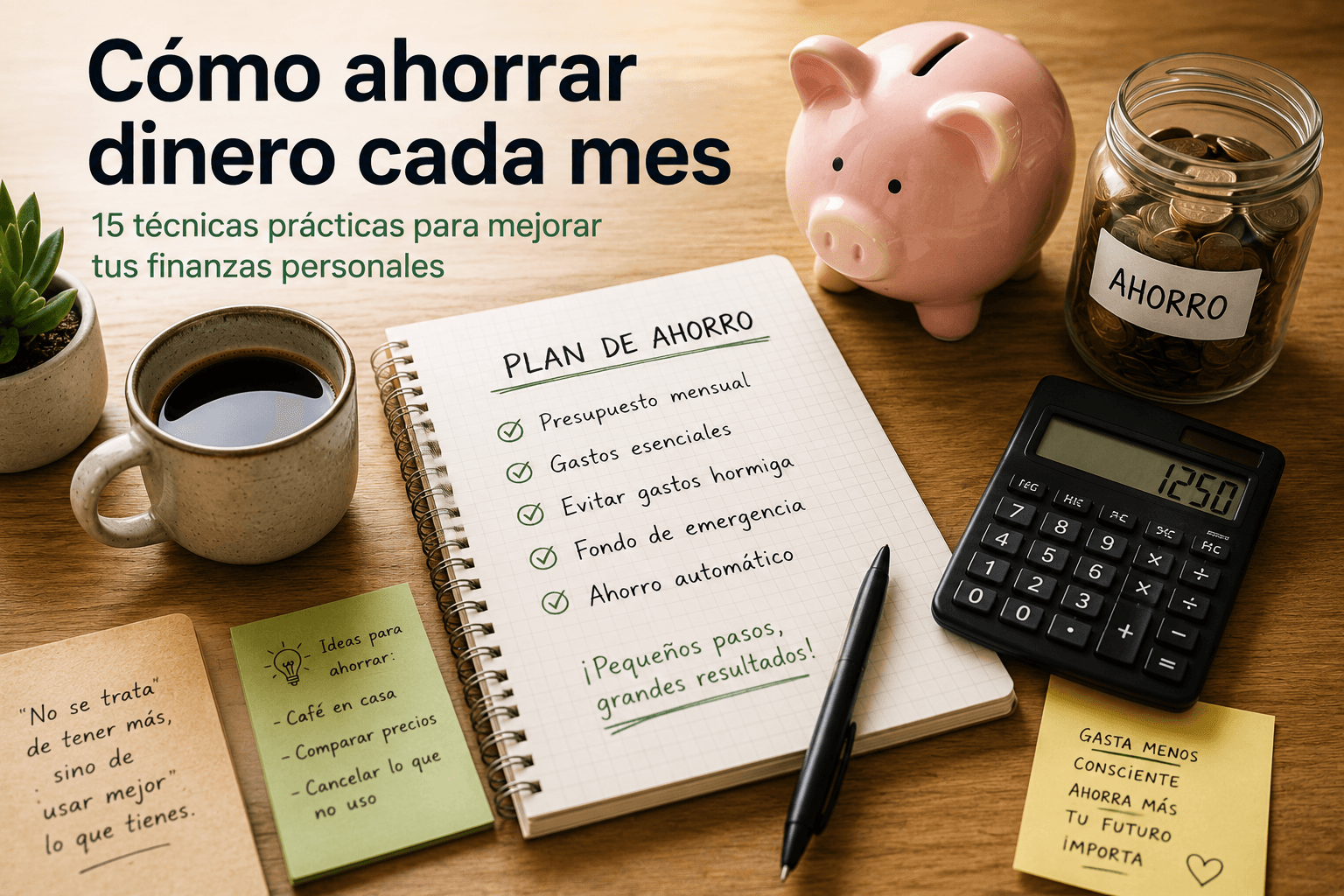
Saving money is not an innate talent that some people are blessedly born with and others are not; it is uniquely and purely a habit that can be trained. However, the theory of saving ("spend less than you earn") is deceptively simple. The practice, surrounded by subscriptions, food delivery, and one-click shopping, is a constant battle against our own neurotransmitters.
If you feel like you systematically reach the end of every month without really knowing where your paycheck evaporated to, you are in the right place. We are not here to tell you to stop drinking your favorite latte, but to present 15 highly proven and structured saving techniques so you can take absolute control of your personal finances and build a calm, predictable future.
Core Strategies: Taming the Psychology of Saving
Before blindly cutting expenses, it is vital to configure your mind and your banking environment so that saving requires less willpower than spending.
1. Pay yourself first (Automatic Pre-Saving)
This is, without a doubt, the golden rule of personal finance. Instead of saving "what's left at the end of the month" (which magically tends to be zero), you must save before spending. How to apply it: Set up an automatic transfer from your main income account to a secondary savings account, scheduled to execute on the same day you receive your salary. What you don't see in your main balance, you don't spend.
2. The famous 50/30/20 rule
An exceptionally popularized template, ideal for baseline budgets. Strictly divide your net monthly income into three untouchable categories:
- 50% Basic Needs/Survival: Rent, mortgage, utility bills, groceries, transportation to work.
- 30% Wants and Leisure: Restaurants, movies, hobbies, non-essential clothing, streaming platform subscriptions.
- 20% Savings and Investments: Extra debt payments, emergency fund, investments in index funds.
3. The Kakebo Method (Japanese Mindful Journaling)
For those whose money disappears into absurd small expenses, this traditional method is infallible because it introduces "friction". It requires you to separate your monthly expenses into four simple broad categories: Survival, Optional/Vices, Culture, and Extras.
4. The 30-Day Cooling-off Rule for Wants
The great lethal enemy of massive savings is always the damn impulsive Amazon purchase at 1 AM. Next time you feel the irresistible urge to buy something you do not need to survive (new headphones, a watch, another bag), write it down on a list and strictly wait 30 long days. The result: 80% of the time, the euphoria and dopamine of the novelty will have dissipated and you won't want it anymore.
5. 52-Week Challenge (Progressive Saving)
Ideal for gamifying saving if you've never achieved it in the past. It involves saving the equivalent of the week of the year you are in. Week 1 you save $1; week 2, $2... and you finish the grueling week 52 saving $52. The final prize: By the end of the demanding year, you will have cleanly accumulated the surprising figure of $1,378 almost without realizing it.
Trench Tactics: Smart Expense Cutting
Once the long-term mental strategy is set, it's time to get your hands dirty scraping bills directly in the day-to-day.
6. Relentless Hidden Subscription Audit
With the advent of the subscription economy, families literally waste hundreds of dollars annually. Review your bank movements for the last 3 months and cancel gyms you don't step into, redundant streaming platforms, and annoying duplicate insurances kept by inertia.
7. Grocery Shopping on a Full Stomach
Never underestimate the immense manipulative power of hunger. Going grocery shopping hungry tragically ensures you will throw expensive ultra-processed foods and compulsive dispensable treats into your cart. Always go after eating and with a rigid, closed list pre-made at home.
8. The Cash Shield (Physical Envelopes)
The Contactless card is dangerous because the expense is absolutely invisible and painless in our brain. Try taking out your exact "Leisure" and "Groceries" budget at the beginning of the week in hard cash bills and divide it into two envelopes. When an envelope is empty, the spending tap is automatically shut off until next week. It's tough, but incredibly functional.
9. The Magic of Meal Prepping (Batch Cooking)
Eating out or ordering noisy office lunches delivery during your break unpredictably drains an extra $200 a month without you noticing. Dedicate boring dead Sunday afternoons to compulsively cook several abundant tupperware containers at once. Your wallet and silent health will immensely thank you.
10. Open Negotiation and Annual Variable Contract Audit
Your dark utility company, the monopolistic internet provider, and your giant inflexible insurance company count exactly on your absolute docile comfortable inertia. A simple cold lethal annual phone call openly and shamelessly threatening to permanently cancel usually miraculously results in aggressive deep discounts purely for customer retention.
Advanced Techniques and Unconventional Hacks
11. Automatic Change Round-Up
Almost all modern fintech banks allow you to secretly "round up" your purchases. If you buy coffee for $1.20, the app magically charges you a full $2.00 and painlessly banishes and injects the invisible remaining harmless $0.80 straight into your coveted secondary protected savings account. It's a wonderful 100% digital twenty-first-century piggy bank that miraculously grows relentlessly.
12. The Practical Daily Wear Cost-Per-Use Test
Before hastily spending capital on a huge attractive deceptive expensive brand-name garment, calculate its cold amortization or "cost per daily use". An expensive jacket of a whopping $200 that you will actually wear continuously through the cold dense winter will easily be a fantastic, brilliant, and fully efficient flawless investment. But ironically, an uncomfortable flashy cheap dress or whimsical noisy colorful $30 impulse buy for a single fleeting sad wedding night will ironically result in a disproportionately tragic and bleeding expensive decision in the long run.
13. Weekly Zero-Spend Day
Choose one day a week (e.g., Tuesday) where it is strictly forbidden to spend a single dollar. You must use public transport already paid for with your pass, eat what is in the fridge, and not buy coffees outside. This helps reset the mental impulsivity of unconscious consumption.
14. Apply Salary Increases to Savings Immediately
If you get a promotion or a raise, do not inflate your lifestyle ("lifestyle creep"). Take that extra money you didn't need to survive before and put it entirely into savings. Your standard of living will remain the same, but your savings will skyrocket.
15. Use Mindful Spending Assistants
Nowadays, spreadsheets can generate rejection and abandonment. Start recording every dollar outgoing through conversational AIs that apply the Kakebo philosophy for you. You offload mental responsibility and eliminate friction, but keep your money completely under the radar.